
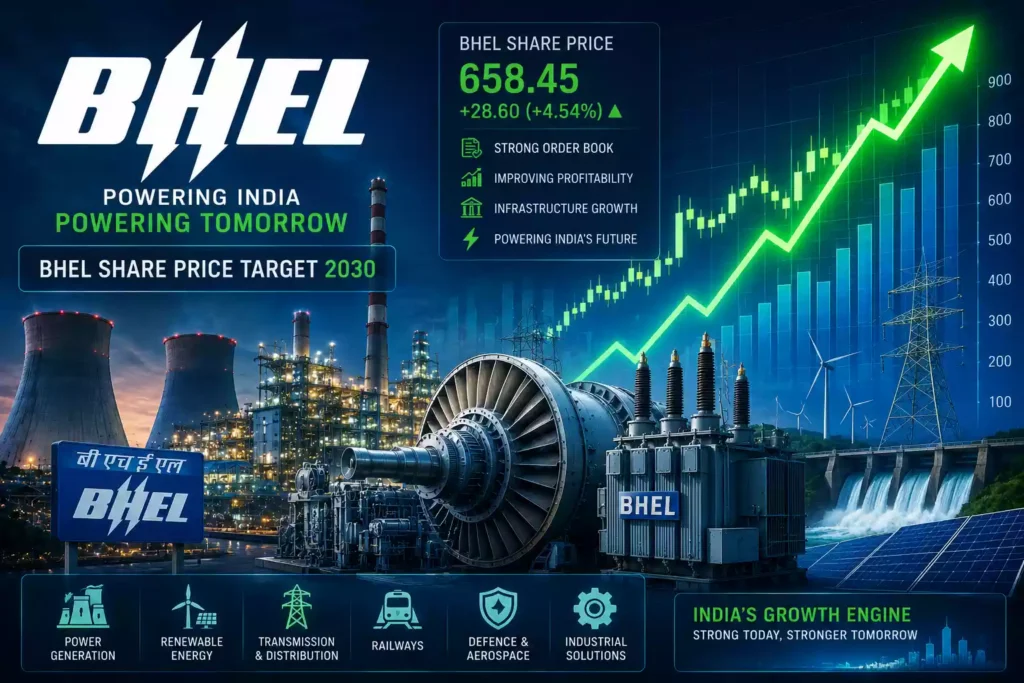
Bharat Heavy Electricals Limited (BHEL) has once again become one of the hottest PSU stocks in the Indian stock market. After years of underperformance, the company is now benefiting from India’s massive power and infrastructure expansion cycle.
Investor sentiment around BHEL has improved sharply due to:
- strong order inflows,
- improving profitability,
- rising government infrastructure spending,
- and a record-breaking order book.
As a result, many investors are now searching for the BHEL share price target 2030 and whether the stock can continue its turnaround story over the next decade.
The big question is:
Can BHEL evolve into a long-term multibagger, or is the recent rally already pricing in most of the future growth?
Let’s explore BHEL’s financials, growth drivers, risks, and realistic long-term share price outlook.
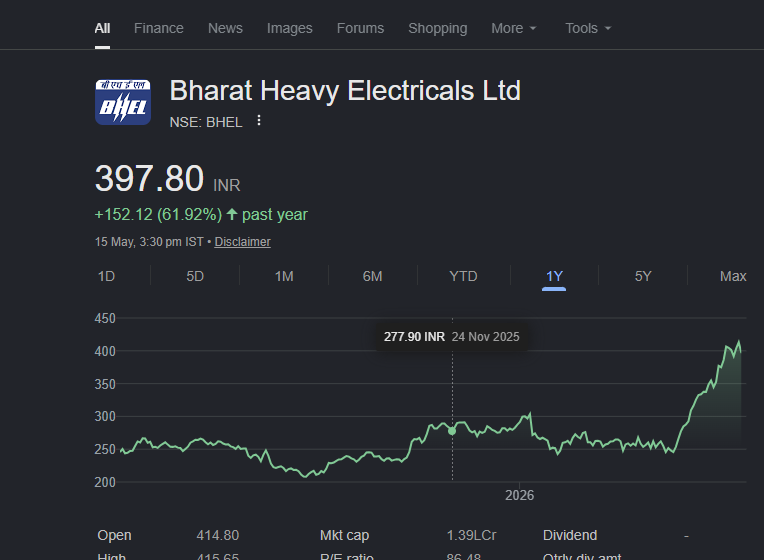
BHEL Share Price Forecast Summary Table
| Year | Bull Case | Base Case | Bear Case |
|---|---|---|---|
| 2027 | ₹550 | ₹420 | ₹250 |
| 2030 | ₹900 | ₹700 | ₹350 |
| 2035 | ₹1,400 | ₹1,050 | ₹500 |
| 2040 | ₹2,200 | ₹1,600 | ₹700 |
These estimates are speculative and depend on:
- India’s power demand,
- execution quality,
- margin expansion,
- and broader market conditions.
Why Is BHEL Share Rising?
BHEL’s recent rally has been driven by a combination of operational improvement and strong investor optimism.
1. Massive Order Book Growth
The company recently reported a record order book of approximately ₹2.4 lakh crore, giving BHEL multi-year revenue visibility.
This is one of the biggest reasons analysts remain bullish on the stock.
2. Strong Revenue & Profit Growth
BHEL reported sharp improvement in FY26 financial performance:
- revenue growth of around 18%,
- Q4 revenue growth of 37%,
- and net profit growth of over 150% YoY.
Improving execution and operating leverage are boosting investor confidence.
3. India’s Power Sector Boom
India is aggressively expanding:
- thermal power,
- renewable energy,
- transmission infrastructure,
- railways,
- and defense manufacturing.
BHEL stands to benefit directly from this infrastructure supercycle.
4. PSU Stock Momentum
Government-owned companies have become increasingly popular among investors due to:
- strong balance sheets,
- infrastructure spending,
- and improving corporate efficiency.
This broader PSU rally has also supported BHEL stock.
Business Overview
BHEL is one of India’s largest engineering and manufacturing companies.
The company operates across:
- power generation equipment,
- transmission systems,
- railways,
- defense,
- industrial equipment,
- and renewable energy solutions.
Historically, BHEL depended heavily on thermal power projects. However, the company is now gradually diversifying into:
- renewable energy,
- EV charging infrastructure,
- battery storage systems,
- and industrial automation.
Its biggest competitive advantage remains its strong relationship with government infrastructure projects.
Financial Analysis
BHEL’s financial turnaround has become significantly stronger over the past two years.
Key Financial Metrics
| Metric | Approximate Value |
|---|---|
| Market Cap | ₹1 lakh crore+ |
| FY26 Revenue | ₹33,782 crore |
| Q4 Revenue Growth | 37% YoY |
| Q4 Net Profit Growth | 156% YoY |
| Order Book | ₹2.4 lakh crore |
| EBITDA Margin | ~14% |
| Dividend | ₹1.40/share |
| Analyst Sentiment | Bullish but valuation cautious |
Revenue Visibility Is Very Strong
BHEL’s order book is now roughly 7x annual revenue, which provides long-term earnings visibility through FY29–FY30.
This reduces uncertainty compared to previous years.
Margins Are Improving
One of the biggest positives is margin expansion.
Q4 FY26 EBITDA margin improved sharply to around 14%, compared to roughly 9% last year.
This suggests:
- better project execution,
- operating leverage,
- and stronger pricing power.
Cash Flow Has Improved
BHEL also reported strong operating cash flow performance due to:
- customer advances,
- improving collections,
- and large infrastructure contracts.
Strong cash flow is essential for large engineering businesses.
Bull Case for BHEL Share
1. India’s Infrastructure Supercycle
India is expected to spend aggressively on:
- electricity generation,
- transmission infrastructure,
- railways,
- and industrial manufacturing over the next decade.
BHEL could become one of the biggest beneficiaries.
2. Thermal Power Revival
Despite renewable growth, India still requires significant thermal power expansion to support rising electricity demand.
This remains highly favorable for BHEL’s core business.
3. Renewable Energy Expansion
BHEL is gradually entering:
- battery storage,
- green hydrogen,
- EV charging,
- and renewable equipment markets.
If execution improves, this could diversify future revenue streams.
4. Operating Leverage Could Boost Earnings
Engineering businesses often experience massive profit growth once revenue scales.
If execution remains strong, margins could continue improving significantly through 2030.
Risks & Bear Case
1. Valuation Concerns
After the recent rally, BHEL’s valuation has become expensive relative to historical levels.
Future returns may depend heavily on continued earnings growth.
2. Execution Risk
Large infrastructure projects involve:
- delays,
- cost overruns,
- and working capital pressure.
Poor execution could hurt margins.
3. Commodity Price Volatility
Rising steel, copper, and raw material prices may pressure profitability.
4. Government Dependency
BHEL still relies heavily on government orders.
Any slowdown in PSU capex or infrastructure spending could impact future growth.
BHEL Share Price Target 2027
By 2027, BHEL may continue benefiting from:
- strong order execution,
- infrastructure expansion,
- and power sector growth.
Bull Case 2027
If earnings growth accelerates and margins improve further, BHEL could potentially move toward higher valuation multiples.
Base Case 2027
Steady revenue growth and execution improvement may support moderate long-term returns.
Bear Case 2027
Project delays or weaker order inflows could pressure sentiment.
BHEL Share Price Target 2030
The BHEL share price target 2030 depends heavily on whether India’s infrastructure and energy investment cycle remains strong.
Key long-term growth drivers include:
- thermal power demand,
- renewable integration,
- railway electrification,
- defense manufacturing,
- and grid modernization.
If BHEL successfully executes its massive order book while improving margins, the company could become one of the strongest PSU turnaround stories of the decade.
However, sustaining rapid growth over multiple years will remain challenging.
BHEL Share Price Target 2035
By 2035, BHEL’s future may depend on how effectively the company adapts to:
- clean energy transition,
- industrial automation,
- and evolving infrastructure technologies.
Potential long-term opportunities include:
- hydrogen infrastructure,
- battery systems,
- smart grids,
- and export expansion.
BHEL Share Price Target 2040
Forecasting stocks 15 years into the future involves substantial uncertainty.
However, India’s:
- industrial growth,
- energy demand,
- and infrastructure modernization
could continue supporting engineering companies like BHEL for decades.
Bull Case 2040
If BHEL successfully transforms into a diversified energy and infrastructure giant, the upside could remain significant.
Base Case 2040
More realistically, the company may mature into a slower but stable infrastructure business.
Bear Case 2040
Technological disruption or weaker competitiveness could limit long-term growth.
Is BHEL a Good Investment Right Now?
BHEL may appeal to:
- long-term PSU investors,
- infrastructure-focused investors,
- and investors bullish on India’s industrial growth story.
However, the stock may be less suitable for:
- conservative income investors,
- low-volatility portfolios,
- or short-term traders chasing momentum.
Investors should monitor:
- order inflows,
- margin sustainability,
- project execution,
- and valuation levels carefully.
Final Verdict
BHEL has staged one of the strongest turnarounds among Indian PSU companies in recent years.
The company’s:
- massive order book,
- improving profitability,
- strong government support,
- and infrastructure exposure
create meaningful long-term potential.
However, investors should also remain cautious about:
- valuation risks,
- execution challenges,
- and cyclical volatility.
The BHEL share price target 2030 remains optimistic overall, especially if India’s infrastructure supercycle continues over the next decade.
For long-term investors bullish on India’s power and industrial growth story, BHEL remains one of the most closely watched PSU stocks in the market.
FAQ Section
Is BHEL a good long-term investment?
BHEL may offer strong long-term growth potential due to India’s infrastructure and power sector expansion, although the stock remains cyclical and volatile.
Why is BHEL stock rising?
The stock has rallied due to:
- strong earnings growth,
- record order book,
- improving margins,
- and rising infrastructure spending.
What is the biggest strength of BHEL?
Its large order book and strong government infrastructure exposure remain its biggest strengths.
What are the biggest risks for BHEL investors?
Major risks include:
- project delays,
- valuation pressure,
- commodity inflation,
- and execution challenges.
Can BHEL benefit from renewable energy growth?
Potentially yes. The company is gradually expanding into:
- battery systems,
- EV charging,
- green hydrogen,
- and renewable infrastructure.
Disclaimer
This article is for informational purposes only and should not be considered financial advice. Investors should conduct their own research before making investment decisions.
Recommended Posts
- IonQ Stock Prediction 2030: Can Quantum Computing Create the Next Multi-Bagger?
- BHEL Share Price Target 2030: Long-Term Forecast, Analysis & Future Outlook
- SoundHound AI Stock Prediction 2027, 2030 & 2040
- Palantir Stock Forecast 2027, 2030 & 2040: PLTR Price Prediction and Long-Term Outlook
- Adani Power Share Price Target 2030: Long-Term Forecast, Growth Potential & Investment Outlook